
Halwa is a family of sweets, not one recipe
In India, “halwa” covers many desserts that share a slow cook and a spoonable or sliceable body, but not the same grain or fat. Search results mix carrot pudding, moong-dal fudge, cornflour slices, and Tirunelveli wheat milk as if they were twins. They are not. This article lists the main types, then explains why Tirunelveli-style wheat halwa, Karupatti wheat halwa, and Moscoth wheat halwa have a reputation that rava or gajar halwa does not try to copy - and why Crescent’s Moscoth line, cooked like our other wheat flavours, is the pack to choose when you want that wheat-forward taste without maida.
Common types of halwa in India
Wheat (godhumai) - Tirunelveli style
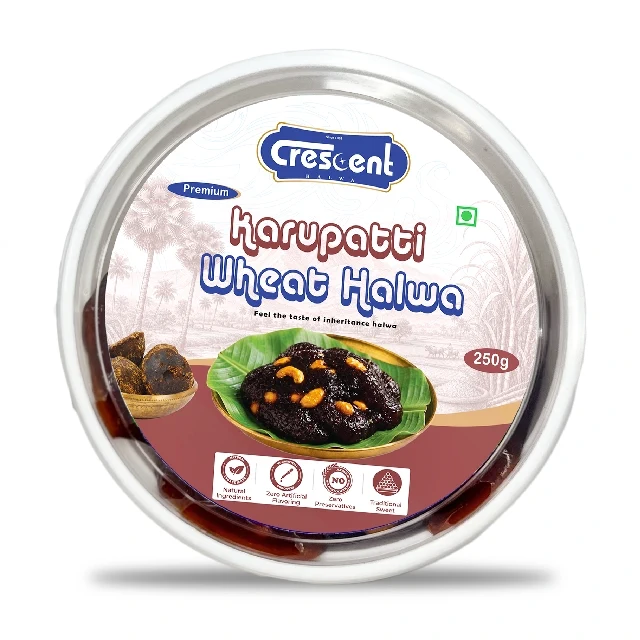
Soaked wheat is ground and strained into wheat milk, then cooked with sugar (or palm jaggery) and a large amount of ghee until glossy. This is the Nellai classic. Crescent’s Tirunelveli, Karupatti, and Moscoth lines all live in this family. Home quantities are in the Tirunelveli halwa recipe and Karupatti halwa recipe.
Moscoth wheat halwa
Moscoth is not a fourth dessert family. It is a named traditional wheat flavour inside the Tirunelveli-style process: wheat extract, pure ghee, slow cook, glossy body. Where classic Tirunelveli is the sugar-and-wheat profile people already search for, Moscoth is the wheat-forward expression - the taste of the grain and ghee first, not palm jaggery, not a mixed mithai tray. Crescent spells it Moscoth on packs so you can reorder the same variant. Read what Moscoth wheat halwa is and how it is made.
Sooji / rava halwa
Semolina roasted in ghee with sugar and water or milk. Fast, homely, often made for festivals in North and South kitchens. It is not wheat-extract halwa. The grain is different; the cook is minutes, not hours.
Gajar (carrot) halwa
Grated carrot reduced with milk and ghee, often with khoya. A winter North Indian staple. Famous, beloved, and still a vegetable-and-milk pudding rather than a wheat kadai sweet.
Moong dal halwa
Lentil paste cooked in ghee until the raw smell goes. Rajasthan and many North wedding menus rely on it. Madurai’s Ashoka-style halwa sits closer to this lentil-and-ghee world than to Tirunelveli wheat milk. Do not order “Tamil Nadu halwa” and assume you will get wheat.
Badam, atta, lauki, and other milk-reduction halwas
Almond paste, wholewheat flour, or bottle gourd, cooked down with ghee and sugar. Each has a region and a season. They share the word “halwa,” not the Tirunelveli process.
Karachi / Bombay (cornflour) halwa
A set, often colourful slice made from starch or refined flour (maida), sugar, and fat, with nuts. It travels well and looks like a gem. It is not wheat extract. Texture is jelly-firm rather than ghee-gloss wheat. If a pack is cheap and neon, suspect maida or cornflour - not Samba godhumai.
Kozhikode (Calicut) black halwa
Kerala’s famous dark slab, typically rice or refined flour with jaggery or sugar and coconut or banana notes depending on the shop. Neighbour to Tamil Nadu, different grain and colour story. Mentioned here so a “South Indian halwa” search does not collapse Nellai wheat milk and Kozhikode into one bite.
Why Tirunelveli-style wheat halwa is famous
- A process people can name. Wheat milk, not a flour dump. Hours of stirring. Ghee added so the mass shines. That story is tied to a place - Tirunelveli - the way Darjeeling is tied to tea. Visitors remember the counter; families remember the texture.
- It is not a five-minute sweet. Difficulty became reputation. A glossy wheat halwa signals labour and ghee, which is why it is gifted and why cheap copies use colour and shortening.
- It ships when it is cooked properly. A finished wheat-and-ghee sweet, packed without preservatives, can travel in a pouch or tin. That is how a regional kadai became a pan-India product. Crescent’s retail and wholesale packs exist for that reason.
More on uniqueness: what makes Tirunelveli halwa unique.
Why Karupatti wheat halwa is famous among those types
Karupatti (palm jaggery) is a Tamil pantry ingredient - palmyra country, Pongal kitchens, older home sweets. Putting it into the same wheat-extract kadai as Nellai sugar-wheat halwa creates a flavour people can argue about: darker, caramel, less one-note sugar, finished with cardamom and dry ginger. It stands out in a country full of white-sugar mithai without pretending to be a health food.
It is famous in the way a named variant is famous: shoppers who already know wheat halwa want a second authentic expression. Mixed mithai halls rarely give palm jaggery wheat its own honest SKU. Crescent does, next to classic Tirunelveli and Moscoth. Compare them in Karupatti vs Tirunelveli.
Why Moscoth wheat halwa stands out - and why Crescent’s is the one to buy
Moscoth stands out because it is wheat-forward without becoming a different sweet. Buyers who find classic Tirunelveli a little too “sugar-first,” and Karupatti too jaggery-dark, land on Moscoth: same kadai family, a traditional wheat flavour they can name on a gift card. Compare it with palm jaggery in Moscoth vs Karupatti wheat halwa.
Crescent Moscoth wheat halwa is the best version of that idea we cook, for reasons that apply to all our halwa - Tirunelveli, Karupatti, and Moscoth - not a slogan on one tin:
- Premium-grade Samba wheat, not maida. We extract wheat milk from Samba godhumai. Maida (refined flour) makes a paste or a jelly slice; it cannot give the glossy body of Nellai-style wheat halwa. If a “Moscoth” or “wheat” sweet is cheap, pale, and pasty, it was probably not Samba extract.
- Firewood cooking. We cook on firewood, not a rushed gas-only shortcut. Slow, uneven-in-a-good-way heat is part of why the aroma sits in the ghee. See firewood vs gas cooking.
- Cast-iron pan. The mass is worked in a cast-iron pan (kadai). Cast iron holds heat and lets the wheat-and-ghee emulsion cook evenly without the thin-pan scorch that turns a batch bitter. That pan, with firewood, is the taste people call “unique” and then cannot copy on a non-stick stove.
- Pure ghee, no preservatives, named packs. Moscoth is a labelled variant - pouch, gift box, tin - so you do not receive a mystery slab. The same kitchen standard as our other flavours, 50+ years of heritage, pan-India when you order a clear pack.
That is the whole argument for Crescent Moscoth: Samba wheat extract, firewood, cast iron, ghee, and a name on the box. It is not maida halwa with a rustic font.
How to choose
Want carrot and milk? Make or buy gajar halwa. Want a quick festival spoon sweet? Rava. Want a set colourful slab? Karachi style (often maida or cornflour). Want the Tamil wheat-kadai reputation? Tirunelveli-style wheat halwa. Want that kadai with palm jaggery and a spice finish? Karupatti wheat halwa. Want a wheat-forward named variant from the same Samba-wheat, firewood, cast-iron kitchen? Moscoth.
Crescent only competes in that wheat-extract group. We are not a full mithai hall. We cook premium Samba wheat with pure ghee on firewood in a cast-iron pan, with no preservatives, and we label the flavour. If that is the type you came to find, shop the packs or see famous Tamil Nadu shops and why Crescent.